The Solar System Explained For Kids 🪐
Our solar system is our cosmic neighborhood — the Sun, eight planets, moons, asteroids, and comets, all held together by gravity. Let's take a tour through space and meet every member of our solar family!
- 7 mins read
- Includes Video
- Free Worksheets
- 10- Questions Quiz
Learning Objectives
- Explain what the solar system is and what holds it together
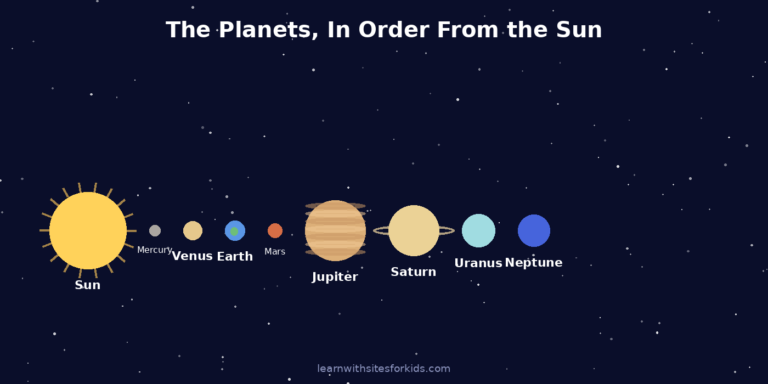
- Name the eight planets in order from the Sun
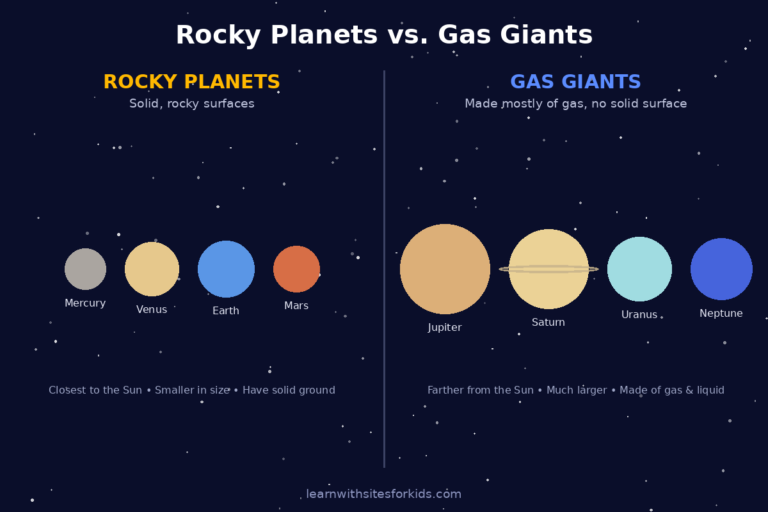
- Describe the difference between rocky planets and gas giants
- Explain why planets orbit the Sun instead of flying off into space
❓ What Is the Solar System?
The solar system is the Sun and everything that travels around it — planets, moons, asteroids, comets, and tiny bits of space dust. “Solar” comes from the Latin word for Sun, since the Sun is the center of it all. Everything in the solar system is held in place by the Sun’s powerful gravity, which keeps the planets moving in their orbits instead of drifting off into space.
Our solar system is just one tiny part of a much bigger galaxy called the Milky Way — but it’s the part we call home.
🎬 Watch & Learn
Meet the Sun
The Sun is a giant star at the center of our solar system, made almost entirely of hydrogen and helium gas. It’s so large that more than a million Earths could fit inside it! The Sun’s gravity is what keeps every planet locked in orbit, and its light and heat make life on Earth possible.
The Eight Planets, In Order
Starting closest to the Sun and moving outward:
- Mercury — the smallest planet, and the closest to the Sun
- Venus — the hottest planet, wrapped in thick clouds
- Earth — our home, the only known planet with life
- Mars — the “Red Planet,” named for its rusty-colored soil
- Jupiter — the largest planet, a giant ball of gas
- Saturn — famous for its beautiful rings made of ice and rock
- Uranus — an icy giant that spins on its side
- Neptune — the farthest planet, and one of the windiest
Rocky Planets vs. Gas Giants
The four planets closest to the Sun — Mercury, Venus, Earth, and Mars — are called rocky planets because they have solid, rocky surfaces you could (in theory) stand on.
The four planets farthest from the Sun — Jupiter, Saturn, Uranus, and Neptune — are called gas giants, because they’re made mostly of gas and don’t have a solid surface at all.
🖼️ Illustrations
📖 Vocabulary
-
Orbit
the path a planet follows around the Sun
-
Gravity
the force that keeps planets locked in orbit around the Sun
-
Rocky Planet
a planet with a solid, rocky surface
-
Gas Giant
a large planet made mostly of gas, with no solid surface
-
Galaxy
a massive collection of stars, gas, and dust — our solar system is part of the Milky Way galaxy
NEW Latest Videos
Learn more with latest videos
🧠 Test Your Knowledge
50 Interactive Quizzes
🔗 Related Lessons
💬 Frequently Asked Questions
There are eight official planets. Pluto used to be considered the ninth planet, but in 2006 scientists reclassified it as a “dwarf planet” instead.
The Sun’s gravity pulls the planets toward it, but each planet is also moving forward fast enough that it keeps missing the Sun — this balance is what creates a stable orbit.
Venus is usually the closest planet to Earth, though Mercury and Mars take turns being closest depending on where all the planets are in their orbits.