
MATH · GRADE 3–6
Comparing Fractions for Kids
Greater Than, Less Than & Equal Fractions
Comparing fractions means deciding which fraction is greater, which fraction is less, or whether two fractions are equal. Kids can compare fractions using pictures, fraction strips, number lines, common denominators, and simple rules.
Learning Objectives
- Understand what it means to compare fractions
- Use greater than, less than, and equal signs.
- Compare fractions with the same denominator.
- Compare fractions with the same numerator.
- Recognize equivalent fractions
❓What Does Comparing Fractions Mean?
To compare fractions, we look at two or more fractions and decide how their values are related.
We use these signs:
> means greater than
< means less than
= means equal to
Example:
1/2 > 1/4This means one half is greater than one quarter.
Comparing Fractions With the Same Denominator
When fractions have the same denominator, they are divided into the same number of equal parts. To compare them, look at the numerator.
Example:
3/8 and 5/8Both fractions have the denominator 8. That means both wholes are divided into 8 equal parts.
Now compare the numerators:
3 and 5Since 5 is greater than 3:
5/8 > 3/8Simple rule:
Same denominator? Bigger numerator means bigger fraction.Comparing Fractions With the Same Numerator
When fractions have the same numerator, look at the denominator.
Example:
1/2 and 1/4Both fractions have numerator 1. That means we are looking at one part.
But the denominators are different.
1/2 means the whole is divided into 2 equal parts.
1/4 means the whole is divided into 4 equal parts.
If the whole is the same size, one half is bigger than one quarter.
So:
1/2 > 1/4Simple rule:
Same numerator? Smaller denominator means bigger pieces.Why Does a Bigger Denominator Sometimes Mean a Smaller Fraction?
This is one of the most important fraction ideas.
If you cut a pizza into 2 equal slices, each slice is large.
If you cut the same pizza into 8 equal slices, each slice is smaller.
So:
1/2 > 1/8Even though 8 is bigger than 2, one eighth is smaller than one half because the whole was divided into more parts.
Comparing Fractions on a Number Line
A number line can also help compare fractions. Fractions closer to 1 are greater. Fractions closer to 0 are smaller.
Example:
0 ----- 1/4 ----- 1/2 ----- 3/4 ----- 1On this number line:
3/4 is greater than 1/2
1/4 is less than 1/2
1/2 is greater than 1/4
Comparing Fractions Using Equivalent Fractions
Sometimes fractions have different numerators and different denominators. Equivalent fractions can help.
Example:
1/2 and 2/6Change 1/2 into an equivalent fraction with denominator 6:
1/2 = 3/6Now compare:
3/6 and 2/6Since 3 is greater than 2:
3/6 > 2/6So:
1/2 > 2/6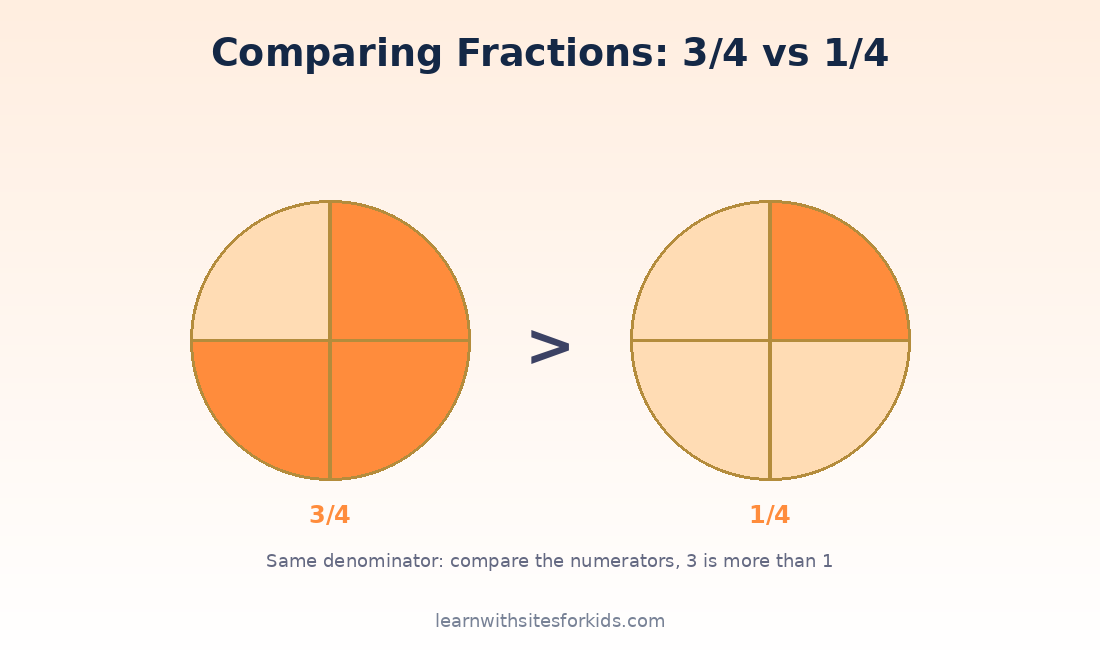
Comparing Fractions
The fractions are:
3/4 and 1/4Since 3 shaded parts are more than 1 shaded part:
3/4 > 1/4Vocabulary
-
Greater Than
More than. The sign is >.
-
Less Than
More than. The sign is >.
-
Compare
To look at two or more numbers and decide which is greater, less, or equal.
-
Equal To
The same value. The sign is =.
-
Equivalent Fractions
Fractions that look different but have the same value.
NEW Latest Videos

Learn more with latest videos

🧠 Test Your Knowledge

50 Interactive Quizzes
Frequently Asked Questions
A half is one of two equal parts. It is written as 1/2.
A third is one of three equal parts. It is written as 1/3.
A quarter is one of four equal parts. It is written as 1/4.
Yes. One quarter and one fourth mean the same thing.
One half is bigger than one quarter when both fractions are part of the same-size whole.
Join 10,000 Young Explorers
Get a FREE worksheet