
Dive into the mystery of black holes — objects with gravity so strong that not even light can escape.
Perfect for young space explorers ready to learn something mind-bending.
Learning Objectives
 How It Forms
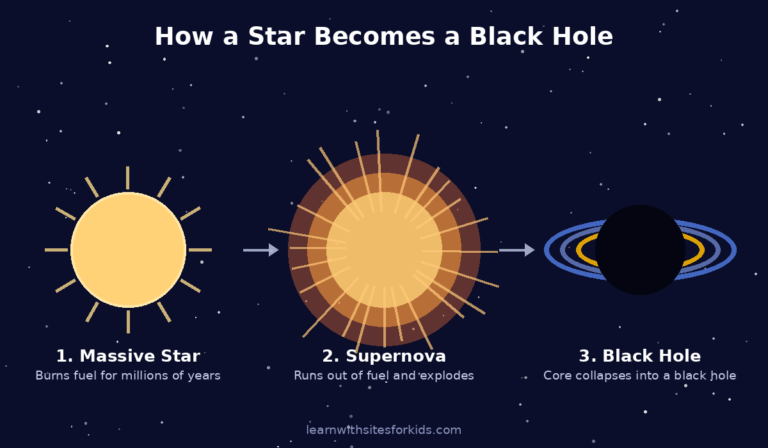
Most black holes form at the end of a massive star’s life. Stars exist because of a balance between two forces — gravity pulling inward, and the enormous energy from nuclear fusion pushing outward. This tug of war keeps a star stable for millions or billions of years. But when a star at least 20 times the mass of our Sun runs out of fuel, fusion stops. Gravity wins. The outer layers collapse inward with such force that they explode outward in a colossal event called a supernova — and the core is crushed into a singularity. A black hole is born.
 How Many Are There?
Scientists estimate there are around 100 million stellar black holes in the Milky Way alone. But there are also supermassive black holes — found at the centres of most large galaxies — which can have the mass of millions or even billions of Suns. The supermassive black hole at the centre of our own Milky Way is calledSagittarius A*and has the mass of about 4 million Suns.
Near some extremely massive black holes, time could pass much more slowly than on Earth. In science fiction examples, one hour near a black hole may equal years far away.
What Is Spaghettification? 
This is not just a fun name — it is the actual scientific term used by physicists in real academic papers, and it describes something genuinely extraordinary. If you fell feet-first toward a black hole, the gravitational pull on your feet (being closer to the black hole) would be dramatically stronger than the pull on your head. This difference in gravitational pull across your body is called a tidal force.
Near a black hole, this difference becomes so extreme that your body would be stretched vertically into a long, thin strand — and simultaneously compressed horizontally. Physicists call this process spaghettification. The good news: this only happens extremely close to a black hole. From a safe distance, a black hole is simply a very massive object, like any other.
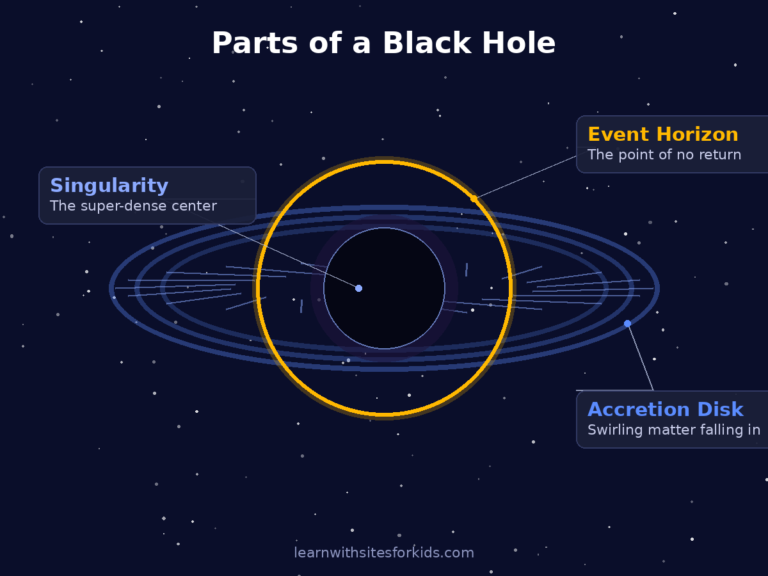
Labeled diagram of Black Hole
Illustrations
📖 Vocabulary
NEW Latest Videos

Learn more with latest videos

🧠 Test Your Knowledge

50 Interactive Quizzes