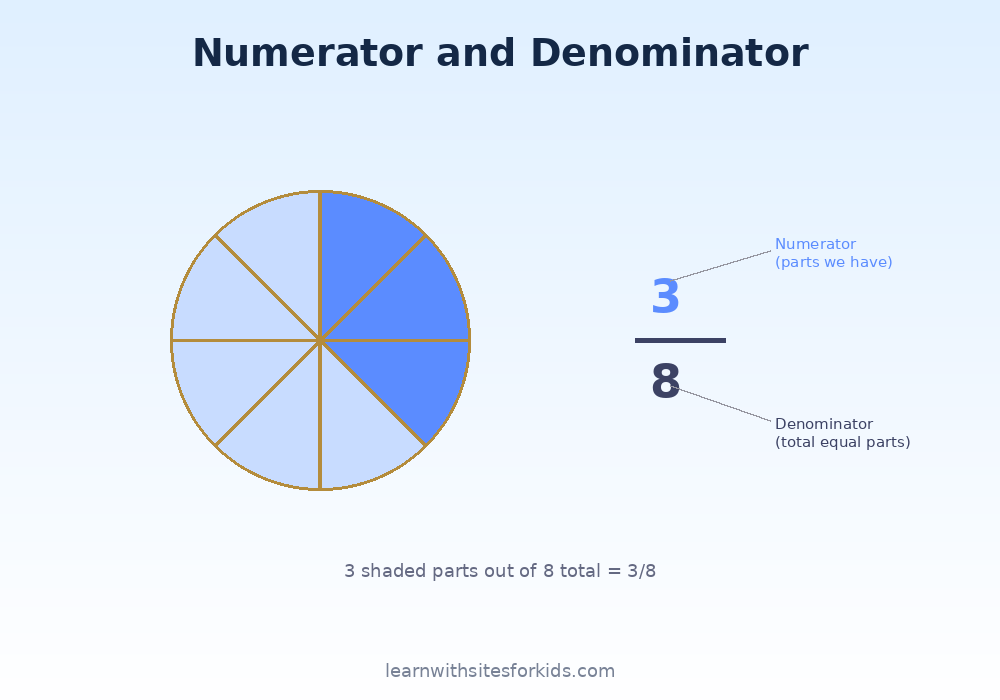
Identify the numerator and denominator in any fraction
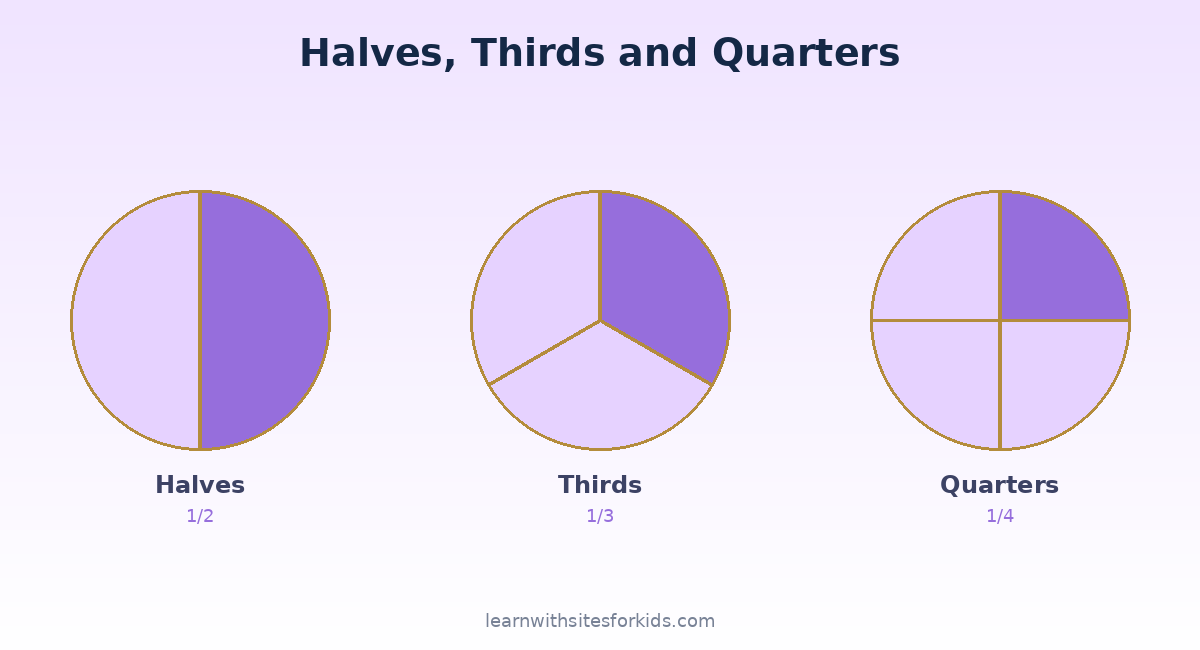
Recognize and work with halves, thirds, and quarters
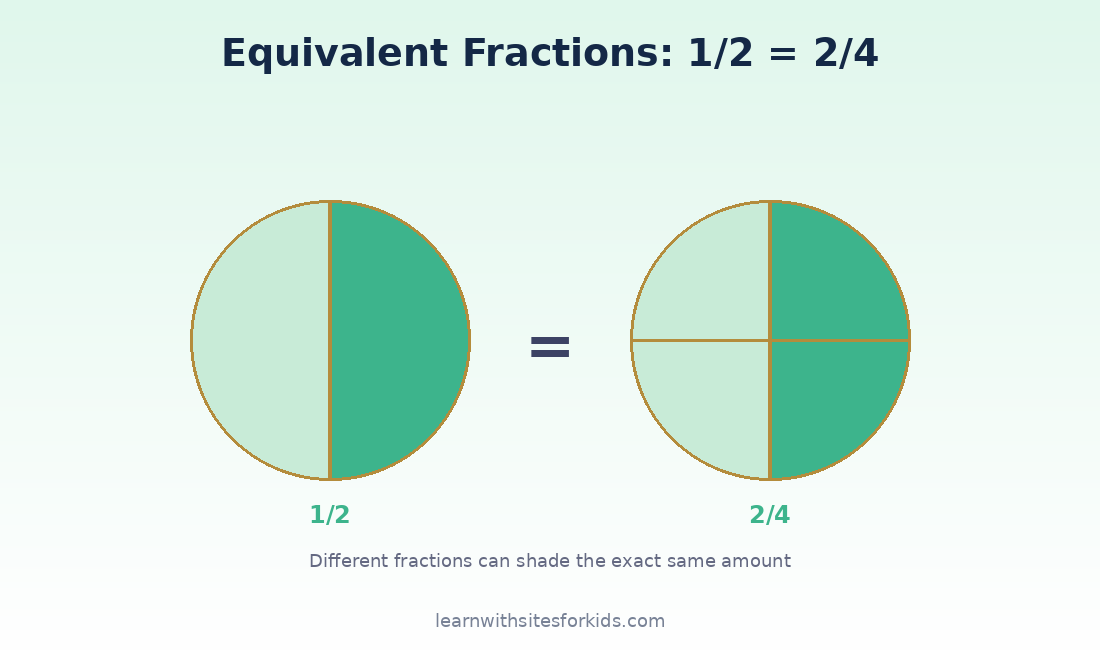
Find equivalent fractions
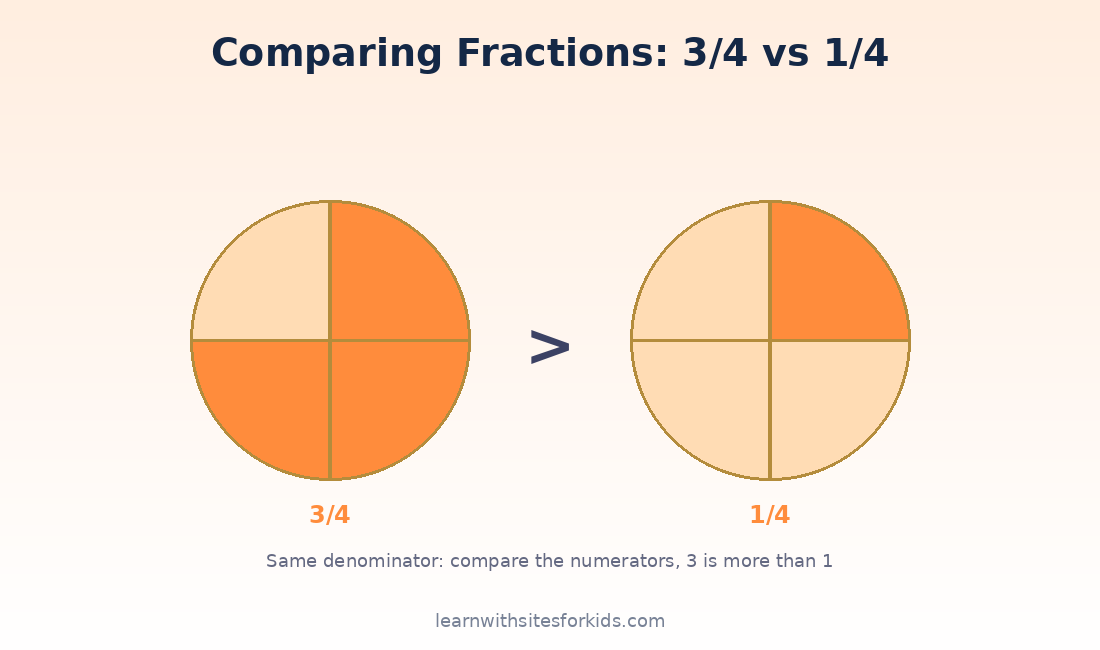
Compare fractions to know which is bigger or smaller
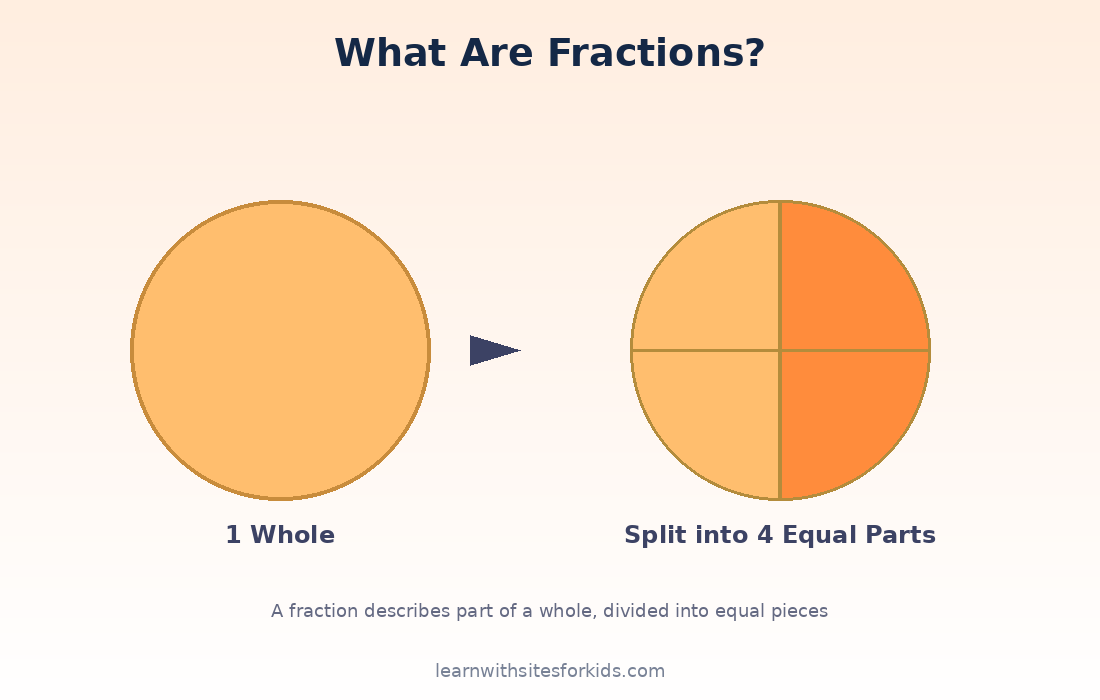
❓ What Are Fractions?
A fraction shows part of a whole. Whenever something is split into equal pieces, a fraction tells us how many of those pieces we have compared to the total number of pieces. Fractions show up everywhere — sharing a pizza, splitting a chocolate bar, measuring ingredients in a recipe, or telling time (“quarter past three”).
📚 Explore Fraction Lessons
Choose a number topic below and start learning step by step. Each lesson includes simple explanations, examples, practice activities, quizzes, and printable worksheets.
Finding a common denominator (a shared multiple of both denominators) lets you compare numerators directly, the same trick used in equivalent fractions.
This section is best for elementary students, especially Grades 1–4. Some topics, like decimals, integers, percentages, and ratios, are better for older students in Grades 5–8.
Parents can help by counting everyday objects, reading numbers on signs, comparing prices while shopping, practicing time and money, playing number games, and using printable worksheets for extra practice.
Join 10,000 Young Explorers
Get a FREE worksheet
Cookie Consent
We use cookies to improve your experience on our site. By using our site, you consent to cookies.
Contains information related to marketing campaigns of the user. These are shared with Google AdWords / Google Ads when the Google Ads and Google Analytics accounts are linked together.
90 days
__utma
ID used to identify users and sessions
2 years after last activity
__utmt
Used to monitor number of Google Analytics server requests
10 minutes
__utmb
Used to distinguish new sessions and visits. This cookie is set when the GA.js javascript library is loaded and there is no existing __utmb cookie. The cookie is updated every time data is sent to the Google Analytics server.
30 minutes after last activity
__utmc
Used only with old Urchin versions of Google Analytics and not with GA.js. Was used to distinguish between new sessions and visits at the end of a session.
End of session (browser)
__utmz
Contains information about the traffic source or campaign that directed user to the website. The cookie is set when the GA.js javascript is loaded and updated when data is sent to the Google Anaytics server
6 months after last activity
__utmv
Contains custom information set by the web developer via the _setCustomVar method in Google Analytics. This cookie is updated every time new data is sent to the Google Analytics server.
2 years after last activity
__utmx
Used to determine whether a user is included in an A / B or Multivariate test.
18 months
_ga
ID used to identify users
2 years
_gali
Used by Google Analytics to determine which links on a page are being clicked
30 seconds
_ga_
ID used to identify users
2 years
_gid
ID used to identify users for 24 hours after last activity
24 hours
_gat
Used to monitor number of Google Analytics server requests when using Google Tag Manager