Somewhere in the Milky Way — our home galaxy — there are around 100 million objects so powerful that not even light can escape from them. They warp time itself. They can stretch anything that falls into them into a long, thin strand. And if you spent one hour near one, you would return to find that seven years had passed on Earth. These objects are called black holes, and they are the most extreme things in the known universe.
The good news? Black holes are also one of the most fascinating topics in all of science — and understanding them is easier than you might think.
Black Holes Explained for Kids:
🎬 Watch our Black Holes video above for animations of how they work — then read on for the full guide!
What Is a Black Hole? 🕳️
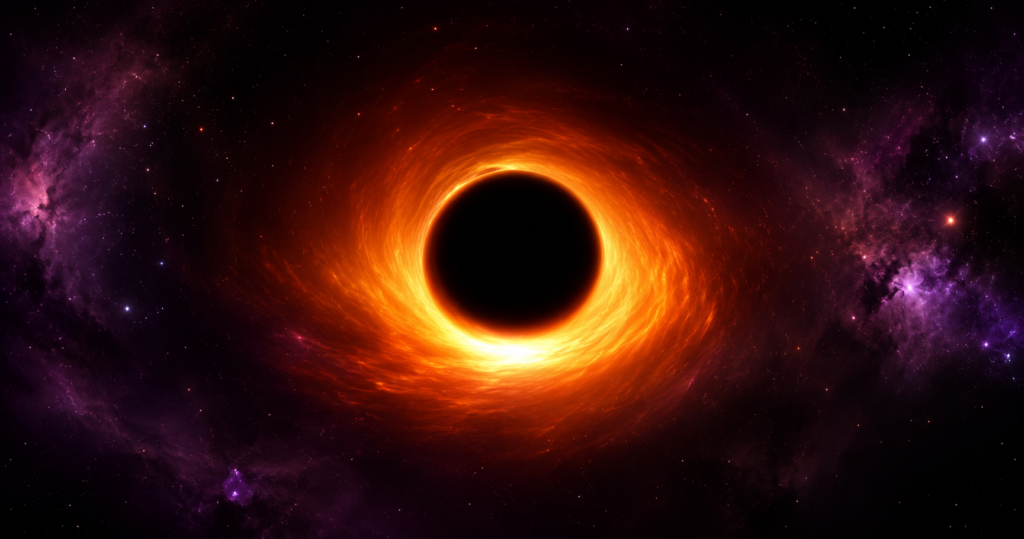
A black hole is a region of space where gravity is so incredibly strong that nothing can escape from it — not matter, not energy, not light. Since no light escapes, black holes appear completely black against the backdrop of space (hence the name). They are not holes in the way we think of a hole in the ground — they are objects, with enormous amounts of mass compressed into an extremely small space.
The boundary around a black hole — the point of no return — is called the event horizon. Once anything crosses the event horizon, it cannot escape. At the very centre of a black hole is a point called the singularity, where all the mass of the original object has been compressed into an infinitely small, infinitely dense point. This is where our best mathematics breaks down and produces impossible answers — one of the biggest unsolved puzzles in all of physics.
How Do Black Holes Form? ⭐
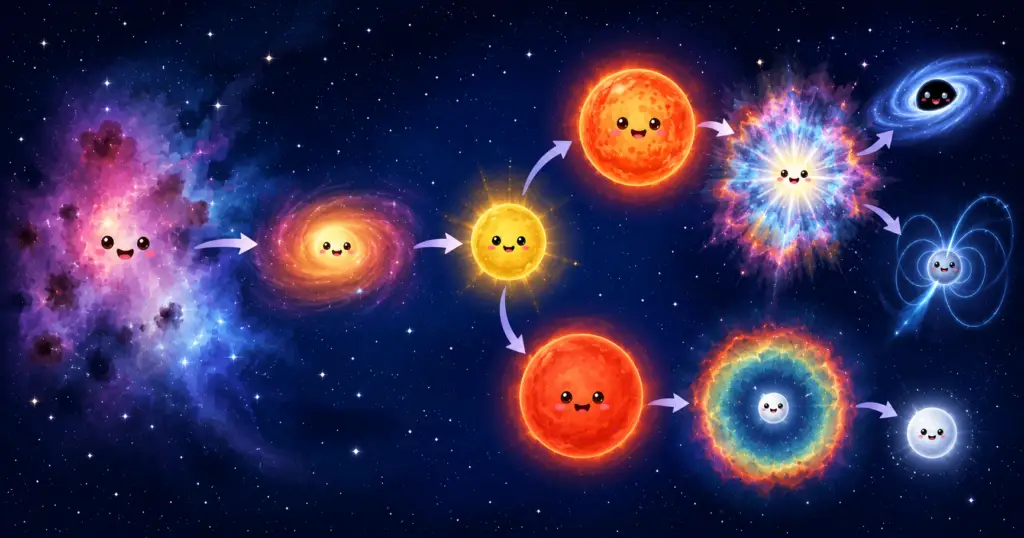
Most black holes form at the end of a massive star’s life. Stars exist because of a balance between two forces — gravity pulling inward, and the enormous energy from nuclear fusion pushing outward. This tug of war keeps a star stable for millions or billions of years. But when a star at least 20 times the mass of our Sun runs out of fuel, fusion stops. Gravity wins. The outer layers collapse inward with such force that they explode outward in a colossal event called a supernova — and the core is crushed into a singularity. A black hole is born.
🤯 How Many Are There?
Scientists estimate there are around 100 million stellar black holes in the Milky Way alone. But there are also supermassive black holes — found at the centres of most large galaxies — which can have the mass of millions or even billions of Suns. The supermassive black hole at the centre of our own Milky Way is calledSagittarius A*and has the mass of about 4 million Suns.
1 Hour Near a Black Hole = 7 Years on Earth 🕐
This is the fact that genuinely sounds like science fiction — but it’s not. In 1915, Albert Einstein’s General Theory of Relativity predicted that massive objects warp the fabric of space and time. The stronger the gravity near an object, the more slowly time passes there compared to somewhere far away from it.
Near a sufficiently massive black hole, this effect becomes extreme. One hour of time passing for someone hovering near the event horizon could equal seven years passing on Earth. This is called gravitational time dilation and has been tested and proven — GPS satellites experience a milder version of this effect every day and must have their clocks constantly corrected to stay accurate.
What Is Spaghettification? 🍝
This is not just a fun name — it is the actual scientific term used by physicists in real academic papers, and it describes something genuinely extraordinary. If you fell feet-first toward a black hole, the gravitational pull on your feet (being closer to the black hole) would be dramatically stronger than the pull on your head. This difference in gravitational pull across your body is called a tidal force.
Near a black hole, this difference becomes so extreme that your body would be stretched vertically into a long, thin strand — and simultaneously compressed horizontally. Physicists call this process spaghettification. The good news: this only happens extremely close to a black hole. From a safe distance, a black hole is simply a very massive object, like any other.
The First Real Photo of a Black Hole 📸
For most of human history, black holes were purely theoretical — mathematically predicted but impossible to see directly since they emit no light. That changed on April 10, 2019, when the Event Horizon Telescope — a global network of eight radio telescopes working simultaneously across four continents — captured the first ever image of a black hole.
The black hole photographed was at the centre of a galaxy called M87, 55 million light-years from Earth. Its mass is 6.5 billion times the mass of our Sun. The image shows a bright ring of superheated gas surrounding a dark central region — the shadow of the event horizon itself. The data required was so enormous (five petabytes — around five million gigabytes) that hard drives had to be physically flown between observatories by aeroplane, as it was too much to send over the internet.
🔬 Do Black Holes Last Forever?
Stephen Hawking predicted in 1974 that black holes are not permanent. Through a quantum mechanics process now calledHawking Radiation, black holes very slowly lose energy over time — and would eventually evaporate completely. However, this process is so slow that a stellar black hole would take longer than 10⁶⁷ years to disappear — far longer than the current age of the universe. No black hole has ever been observed to evaporate.
Quick Recap — Black Holes ✅
- ✅ A black hole is a region where gravity is so strong nothing can escape — not even light
- ✅ Most form when a massive star’s core collapses in a supernova explosion
- ✅ The event horizon is the point of no return. The singularity at the centre is where maths breaks down
- ✅ Gravity slows time — near a black hole, 1 hour = 7 years on Earth (gravitational time dilation)
- ✅ Spaghettification is the real scientific term for being stretched into a strand by tidal forces
- ✅ The first black hole photo was taken in 2019 by a global telescope network
- ✅ Our galaxy has a supermassive black hole at its centre — Sagittarius A* — 4 million solar masses
📖 Related: How Do Stars Form? ⭐ · The Solar System Explained 🌌 · Why Is the Sky Blue? 🌤️ · Dinosaurs Explained 🦖