Look up at the sky on a clear night and you will see hundreds of tiny points of light scattered across the darkness. Each one of those lights is a star — a blazing ball of superheated gas powered by nuclear reactions happening deep in its core. But where do stars come from? How does a star begin? The answer involves some of the most powerful forces in the universe and a journey that takes millions of years to complete.
In this lesson we are going to follow the complete life story of a star — from its birth as a cold, dark cloud of gas floating in space, all the way through its life as a shining sun, to its dramatic death in either a gentle fade or a spectacular explosion.
 Watch our How Do Stars Form video above — then read on for the complete star life story!
What Is a Star? 
A star is a massive ball of hot plasma — an extremely hot gas — held together by its own gravity and powered by nuclear fusion reactions happening in its core. Our own Sun is a star — a fairly average one, about halfway through its 10-billion-year lifespan. There are estimated to be 200–400 billion stars in our Milky Way galaxy alone, and approximately 2 trillion galaxies in the observable universe. The total number of stars in the universe is greater than all the grains of sand on every beach on Earth.
Stage 1 — The Nebula 
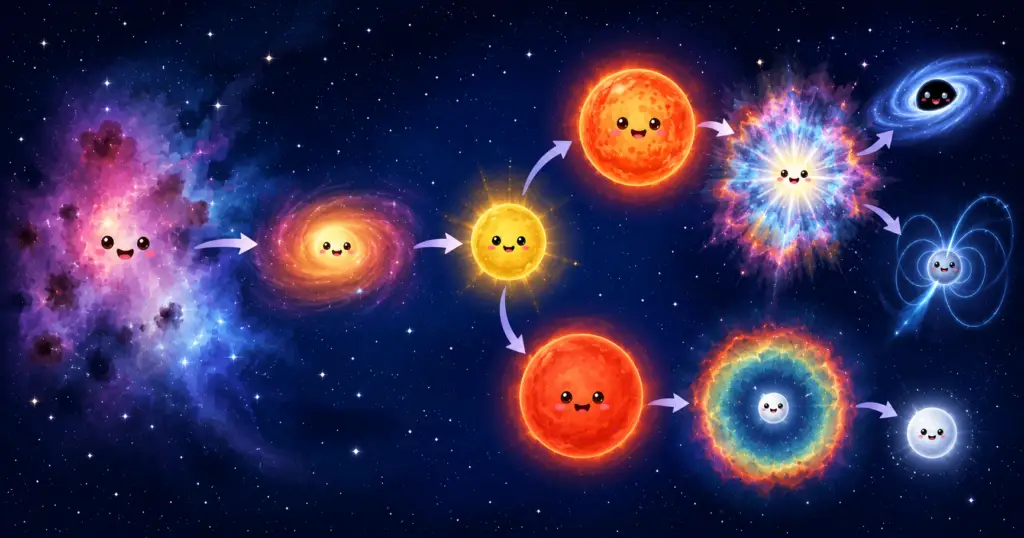
Every star begins its life inside a nebula — a giant cloud of gas and dust floating in space. Nebulae are made mostly of hydrogen and helium — the lightest and most common elements in the universe — along with traces of heavier elements from earlier generations of stars that exploded long ago.
These clouds can be truly enormous — some nebulae are trillions of kilometres across. The famous Orion Nebula, visible to the naked eye on a clear night as a fuzzy patch below Orion’s Belt, is about 24 light years wide and 1,344 light years away from Earth. Stars are forming inside the Orion Nebula right now!
 Wild Fact — Nebulae Are Almost Empty!
Despite being the birthplace of stars, nebulae are extraordinarily sparse. A teaspoon of nebula gas contains fewer particles than the best vacuum humans have ever created in a laboratory. Yet across trillions of kilometres, this incredibly thin gas adds up to enough material to build millions of stars.
Stage 2 — Gravity Pulls the Cloud Together 
A nebula can float quietly in space for millions of years without anything happening. But something eventually disturbs it — perhaps the shockwave from a nearby exploding star, or a collision with another gas cloud. This disturbance causes gravity to begin pulling the gas inward on itself.
As more and more material collects at the centre, the cloud starts to spin (due to conservation of angular momentum — the same principle that makes a spinning ice skater speed up when they pull their arms in). The spinning flattens the cloud into a disc shape, with a dense, hot ball forming at the centre. This hot, dense central object is called a protostar. It is not yet a true star — it has not yet ignited — but it is getting closer every year. This collapse process can take between 100,000 and 1 million years.
Stage 3 — Nuclear Fusion Ignites the Star! 
As the protostar’s core gets denser and hotter, a threshold is eventually reached — approximately 10 million degrees Celsius. At this point, something extraordinary happens: nuclear fusion begins.
Nuclear fusion is the process where hydrogen atoms are forced together under enormous pressure and heat to form helium atoms. This process releases colossal amounts of energy — as both light and heat. The protostar lights up. A true star has been born.
The star now reaches a state of equilibrium — gravity pulling the gas inward is exactly balanced by the outward pressure of energy from fusion. This balance can persist for millions or billions of years, depending on how large the star is. The star has entered what scientists call the Main Sequence — the stable, hydrogen-burning phase of its life. Our own Sun has been on the Main Sequence for about 4.6 billion years and has approximately 5 billion years left.
How Long Do Stars Live? 
Counterintuitively, bigger stars live shorter lives. This is because massive stars burn their fuel at an extraordinarily high rate to maintain equilibrium against their own gravity.
 Blue giant stars (20× Sun’s mass) — live only 10–20 million years
 Yellow stars like our Sun — live about 10 billion years
 Red dwarf stars (smallest type) — can live for trillions of years — far longer than the current age of the universe!
Stage 4 — How Stars Die 
Eventually, every star runs out of hydrogen fuel in its core. What happens next depends entirely on the star’s mass.
Small and Medium Stars (like our Sun)
When a Sun-like star runs out of hydrogen, it expands dramatically into a red giant — swelling to hundreds of times its current size. In our Sun’s case, this expansion will swallow Mercury, Venus and possibly Earth in about 5 billion years. The outer layers are then gently shed as a beautiful glowing shell called a planetary nebula (despite the misleading name, it has nothing to do with planets). What remains at the centre is a tiny, incredibly hot and dense object called a white dwarf — roughly the size of Earth but with the mass of the Sun. Over billions of years, it cools and fades.
Massive Stars (8× the Sun or larger)
Massive stars end in one of the most violent events in the universe: a supernova. When the core of a massive star collapses in a fraction of a second, the outer layers are blasted outward in an explosion so bright it can outshine an entire galaxy of 100 billion stars for weeks or months. What remains is either a neutron star — an incredibly dense object where a teaspoon of material weighs about a billion tonnes — or, if the star was massive enough, a black hole.
 You Are Made of Stardust!
Every element in the universe heavier than hydrogen and helium — including the carbon in your DNA, the iron in your blood, the calcium in your bones, and the gold in jewellery — was created inside a star and scattered across space in stellar explosions. Every atom in your body was forged inside a star billions of years ago. You are literally made of stardust.
Quick Recap — How Do Stars Form? 
- Stars are born inside nebulae — giant clouds of hydrogen and helium gas
- Gravity collapses the cloud inward over 100,000 to 1 million years, forming a protostar
- When the core reaches 10 million°C, nuclear fusion ignites — the star is born!
- Bigger stars burn hotter and die younger — red dwarfs can live trillions of years
- Small stars die as white dwarfs — massive stars explode as supernovas leaving neutron stars or black holes
- Every atom in your body was made inside a star — you are literally stardust!
 Related posts: The Solar System
  · Black Holes Explained
  · Why Is the Sky Blue?
  · Rockets and Space Exploration