
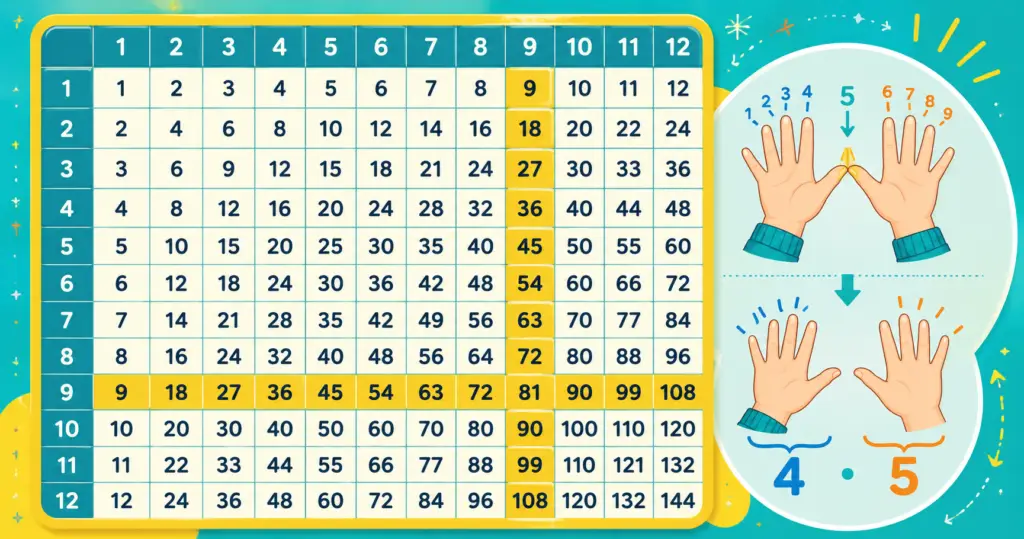
For most kids, learning multiplication tables means one thing: memorizing, memorizing, and memorizing some more. But here’s a secret most classrooms never share — almost every multiplication table has a hidden pattern or shortcut that makes it dramatically easier to learn. Once you see these tricks, numbers that used to feel impossible (looking at you, 7s and 8s) suddenly start to make sense.
In this lesson, we’ll go table by table through the best shortcuts for the trickiest numbers, plus a few wild number facts along the way.
🎬 Watch our Multiplication Tables video above for visual examples — then read on for the full guide!
Why Patterns Matter More Than Memorizing 🧠
Multiplication is really just repeated addition — 4 × 3 means “4 groups of 3,” or 3 + 3 + 3 + 3. Understanding that idea is important, but once you’re working with bigger numbers, recognizing patterns is what actually makes you fast. Mathematicians and even professional “mental math” competitors rely on the exact same shortcuts you’re about to learn — they aren’t cheating, they’re just spotting patterns hiding in plain sight.
The Easiest Tables First 🟢
The 1s Table
Any number multiplied by 1 stays exactly the same. 1 × 7 = 7. That’s it — the easiest table of all!
The 2s Table
Multiplying by 2 just means doubling. 2 × 6 = 12 is the same as 6 + 6. If you can add a number to itself, you already know your 2s table.
The 10s Table
Multiplying by 10 simply adds a zero to the end of the number. 10 × 7 = 70, 10 × 12 = 120. No calculation needed at all — just stick a zero on!
The 5s Table
Here’s a neat one: every answer in the 5s table ends in either 0 or 5, alternating every time — 5, 10, 15, 20, 25, 30… A faster trick: take the number you’re multiplying, cut it in half, then multiply by 10. For 5 × 8: half of 8 is 4, and 4 × 10 = 40. That’s your answer!
The Trickier Ones — With Secret Shortcuts 🟡
The 9s Table — The Finger Trick
The 9s table has one of the most famous tricks in all of elementary math. Hold up both hands, all 10 fingers. To calculate 9 × 4, bend down your 4th finger from the left. Count the fingers BEFORE the bent finger (that’s the tens digit) and the fingers AFTER it (that’s the ones digit). For 9 × 4: 3 fingers before, 6 fingers after — the answer is 36! Try it with any number from 1-10 and it works every single time.
🔢 Another 9s Pattern
Notice that the digits of every answer in the 9s table add up to 9! 9×3=27 (2+7=9), 9×6=54 (5+4=9), 9×8=72 (7+2=9). This works all the way up to 9×10=90 (9+0=9). A great way to double-check your work.
The 11s Table — Just Double the Digit
For any single-digit number times 11, simply write that digit twice! 11 × 3 = 33, 11 × 7 = 77, 11 × 4 = 44. This works perfectly for 1 through 9. (Once you reach 11 × 10 and beyond it changes slightly, but by then most kids have moved on to longer multiplication methods anyway.)
The 6s Table — Built from the 5s and 3s
Struggling with 6s? Break it apart: 6 × n is the same as (5 × n) + n. For 6 × 7: (5×7) + 7 = 35 + 7 = 42. Since the 5s table is so easy, this turns a hard problem into an easy one plus a simple addition.
The 8s Table — Double, Double, Double
Multiplying by 8 means doubling a number three times in a row (since 8 = 2×2×2). For 8 × 5: double 5 to get 10, double 10 to get 20, double 20 to get 40. Three quick doublings beats memorizing from scratch.
The 7s Table — The One Everyone Fears
7 is famously the trickiest table because it doesn’t share a clean pattern with 5, 10 or doubling. The best approach: break it into pieces you already know. For 7 × 8: think of it as (7×5) + (7×3) = 35 + 21 = 56. Or use the fact that 7×8 is one of just a handful of “hard” facts (7×6, 7×7, 7×8, 7×9, 8×8, 8×9, 9×9) that even adults often just memorize directly as a small final group, once every other table has a shortcut.
Multiplying Bigger Numbers — Squares Trick 🎯
Numbers multiplied by themselves (called “squares”) show up constantly in maths. Here’s a neat shortcut for squaring any number ending in 5: take the digit(s) before the 5, multiply by the next number up, then stick “25” on the end. For 25 × 25: the digit before 5 is “2,” and 2 × 3 (the next number up) = 6, so the answer is 625! Try it with 35×35: 3×4=12, so the answer is 1225. It works every single time.
Why Multiplication Tables Actually Matter 🌍
Once multiplication facts become automatic, kids move faster and with more confidence through everything from long division to fractions to algebra. Multiplication also shows up constantly outside school — splitting a restaurant bill, doubling a recipe, calculating how many days are in several weeks, or figuring out total cost when buying multiple items.
🤯 Wild Fact — Ancient Multiplication Without Times Tables
Ancient Egyptians, over 3,000 years ago, multiplied large numbers using ONLY doubling and addition — without ever memorizing a single times table! To multiply 13 × 12, they would repeatedly double 12 (12, 24, 48, 96…) and add together the doublings that corresponded to 13 in binary-like fashion. This method, sometimes called “Egyptian multiplication,” still works perfectly today and is actually similar to how modern computers multiply numbers internally using binary!
Quick Recap — Multiplication Table Tricks ✅
- ✅ 2s = doubling, 10s = add a zero, 5s = half the number, then ×10
- ✅ 9s = the finger trick, and digits of the answer always add up to 9
- ✅ 11s = write the single digit twice (for 1-9)
- ✅ 6s = (5×n) + n. 8s = double three times
- ✅ 7s = break into easier pieces, like (7×5)+(7×3)
- ✅ Squaring numbers ending in 5: multiply the digit before 5 by the next number up, then add “25”
📖 Related: What Are Fractions? 🍕 · The History of Money 💰 · The Human Body Explained 🧠