
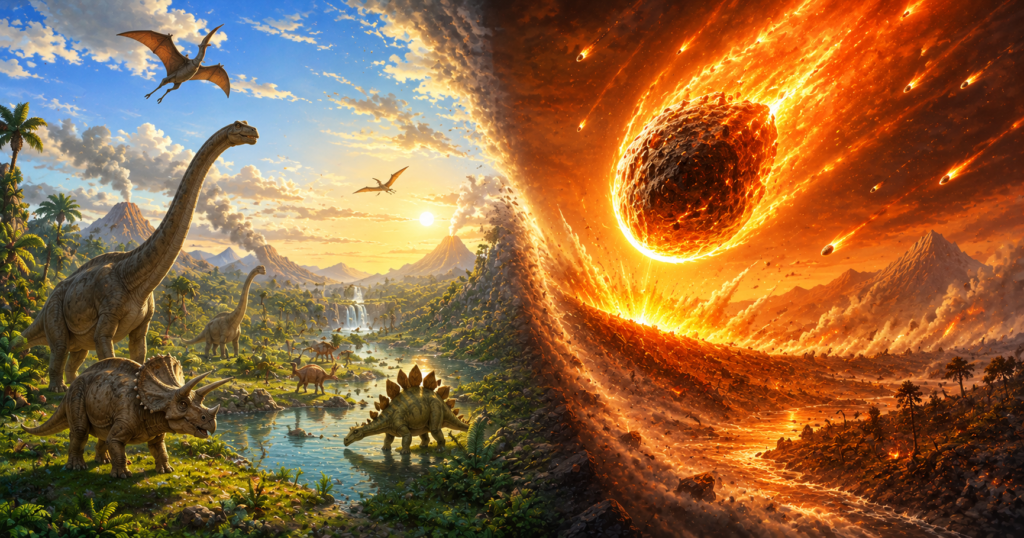
For 165 million years, dinosaurs were the most successful animals to ever walk the Earth. They lived on every continent, came in sizes from as small as a chicken to as large as multiple school buses, and dominated every land ecosystem on the planet. Then, in what scientists describe as a geological “instant” — possibly less than a single day — almost all of them were gone forever. What could possibly cause an entire group of animals, ruling the planet for so long, to vanish so suddenly?
The disappearance of the dinosaurs is one of the most studied events in the history of science — and today, we have more evidence than ever about exactly what happened, when it happened, and why some animals survived while others didn’t.
 Watch our Dinosaur Extinction video above for animations of the impact — then read on for the full story!
The Day Everything Changed 
About 66 million years ago, a massive asteroid — roughly 10 to 15 kilometres wide, about the size of a large city — slammed into Earth at over 64,000 km/h. The impact site is now known as the Chicxulub crater, located near what is today the Yucatán Peninsula in Mexico. The crater itself is about 150 km wide — so big that scientists didn’t even realise it was an impact crater until the 1990s, because it’s mostly hidden underground and underwater.
The energy released by this impact is estimated to have been billions of times more powerful than the largest nuclear bomb ever tested. Within minutes, the impact triggered earthquakes far stronger than anything in recorded history, enormous tsunamis hundreds of metres tall, and wildfires across huge areas of the planet.
How Did the Impact Cause a Mass Extinction? 
The immediate explosion wasn’t actually what killed most species — it was what happened AFTER. The impact threw an enormous amount of dust, rock and soot high into the atmosphere. This material spread around the entire globe and blocked out sunlight for months, possibly years.
Without sunlight:
 Plants couldn’t photosynthesise — many died off within weeks
 Global temperatures dropped sharply — sometimes called an “impact winter,” similar to (but more severe than) a nuclear winter
 Plant-eating dinosaurs starved — with no plants to eat, herbivores died in massive numbers
 Meat-eating dinosaurs starved next — with no herbivores left to hunt, predators followed soon after
Scientists estimate that around 75% of all species on Earth — not just dinosaurs — went extinct during this event. This is known as the Cretaceous-Paleogene extinction event (often shortened to the K-Pg extinction), and it marks the official end of the “age of dinosaurs.”
 How Do We Know This Really Happened?
One of the strongest pieces of evidence is a thin layer of clay found in rock layers all around the world — from this exact time period — containing unusually high levels of a rare metal callediridium. Iridium is extremely rare on Earth’s surface but common in asteroids. Finding this same iridium-rich layer on completely different continents was one of the key clues that led scientists to the asteroid impact theory in the first place.
Were Dinosaurs Already in Trouble Before the Asteroid? 
This is actually a topic scientists still debate! Some research suggests that certain dinosaur groups may have already been experiencing a slow decline in diversity in the millions of years leading up to the impact — possibly due to volcanic activity (a massive series of eruptions called the Deccan Traps in present-day India) gradually changing the climate.
However, other research suggests dinosaurs were still thriving right up until the impact, and that the asteroid alone was sufficient to cause the extinction. Either way, scientists agree the asteroid impact was the final, decisive blow — even if some dinosaur populations were already under stress beforehand.
Wait — Some Dinosaurs DID Survive! 
Here’s something that surprises a lot of people: dinosaurs aren’t actually completely extinct. One group of dinosaurs — a branch that had already evolved feathers, smaller bodies and the ability to fly — survived the extinction event. Today, we call their descendants birds.
Birds are technically classified as dinosaurs by scientists — specifically, they’re the only surviving lineage of a group called theropod dinosaurs (the same broad group that includes T-Rex and Velociraptor). So in a very real sense, dinosaurs never fully disappeared — there are roughly 10,000+ species of “dinosaur” alive today, and you might even have one in a cage in your living room!
 Why Did Some Other Animals Survive Too?
Scientists believe survival often came down to size, diet flexibility, and habitat. Small animals needed less food, could shelter underground, and some — like early mammals, crocodiles, turtles and insects — could survive on a wider range of food sources (including decaying plant matter, insects, or each other) during the years of darkness and cold. Many of our modern animal groups, including mammals, got their big evolutionary opportunity only AFTER the dinosaurs were gone — with less competition for resources and habitats.
What Would Have Happened If the Asteroid Had Missed? 
This is a genuinely fascinating question scientists have studied. Some research suggests that if the asteroid had arrived just a few hours earlier or later, it would have struck deep ocean instead of the shallow coastal area where the Yucatán Peninsula sits today. A deep-ocean impact may have released far less of the sulfur-rich rock that made the “impact winter” so severe and long-lasting — potentially meaning a much smaller extinction event, and dinosaurs might still be the dominant land animals on Earth today!
 Wild Fact — The Asteroid’s “Bad Luck” Timing
Scientists calculated that only about13% of Earth’s surfaceconsists of rock types that, when vaporised by an impact, would release enough sulfur to cause this level of global cooling — and the Yucatán Peninsula happens to sit on exactly that kind of rock. If the asteroid had landed almost anywhere else on the planet, the outcome for life on Earth might have been completely different.
Quick Recap — Why Did Dinosaurs Disappear? 
- About 66 million years ago, a 10-15km wide asteroid struck what is now Mexico, forming the Chicxulub crater
- The impact threw dust and soot into the atmosphere, blocking sunlight for months/years — an “impact winter”
- Plants died first, then plant-eating dinosaurs, then meat-eating dinosaurs — roughly 75% of all species went extinct
- Evidence includes a worldwide iridium-rich clay layer — a chemical signature of the asteroid
- Birds are surviving dinosaurs! One feathered dinosaur lineage survived and is alive today
- The asteroid’s exact landing spot may have made the extinction far worse than it otherwise would have been
 Related: Dinosaurs Explained for Kids · How Do Volcanoes Work?
  · How Do Stars Form?
  · Animal Life Cycles