Right now, somewhere in the world, a tiny droplet of water is evaporating from the ocean, rising invisibly into the sky as vapour. In a few days, that same water might fall as rain on a mountain, flow down into a river, travel hundreds of kilometres, and end up back in the ocean — ready to start the whole journey again. This endless journey is called the water cycle, and it has been running continuously for billions of years. In fact, scientists believe much of the water on Earth today is the very same water that existed when dinosaurs were alive — it has simply been recycled, over and over, forever.
The water cycle (also called the hydrologic cycle) is one of the most important processes on our planet. It’s the reason we have rain, rivers, clouds, snow and fresh drinking water — and understanding it helps explain weather, climate, and why water never “runs out” even though we use it every single day.
 Watch our Water Cycle video above for animated diagrams — then read on for the full guide!
The Four Main Stages of the Water Cycle 
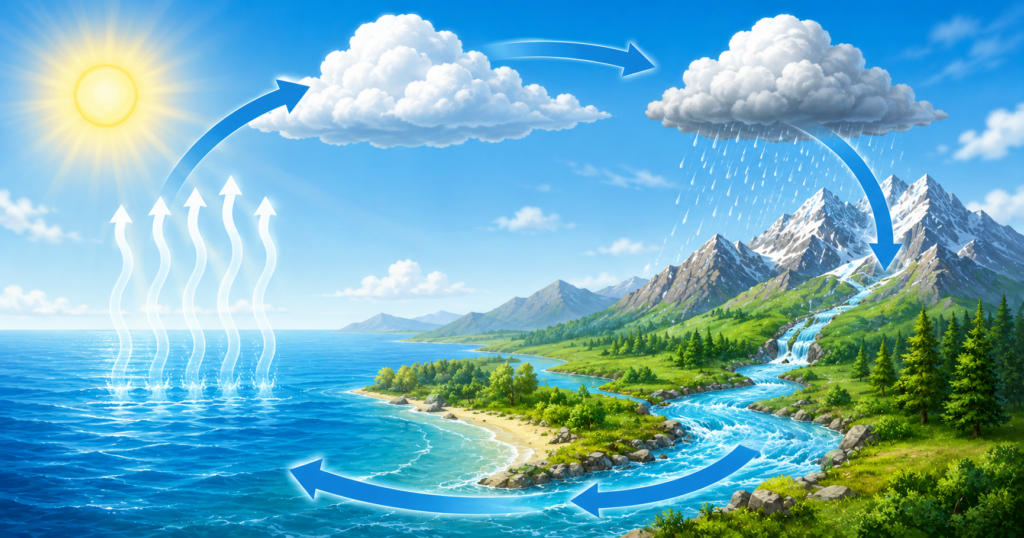
The water cycle has four key stages that repeat continuously. Water doesn’t move through them in a strict order for every single droplet — but together, these four stages describe the whole system:
1. Evaporation 
The Sun heats water in oceans, lakes, rivers and even puddles. When water gets warm enough, it turns from a liquid into a gas called water vapour — and rises invisibly into the air. The ocean is by far the biggest source of evaporation on Earth, since it covers 71% of our planet’s surface.
Plants also release water vapour into the air through their leaves — this is called transpiration, and it’s technically part of the same process. A single large tree can release hundreds of litres of water vapour into the air on a hot day!
2. Condensation 
As water vapour rises higher into the sky, the air gets colder. Cold air can’t hold as much water vapour as warm air, so the vapour begins to condense — turning back from a gas into tiny liquid water droplets. Billions of these tiny droplets clustered together is what forms a cloud.
This is the exact same process you see when a cold drink “sweats” on a hot day — the warm air around the glass cools down, and water vapour from the air condenses into droplets on the outside of the glass.
3. Precipitation 
Inside a cloud, water droplets bump into each other and combine into bigger and bigger droplets. Eventually, they become too heavy for the air to hold up, and they fall back to Earth as precipitation — which could be rain, snow, sleet or hail, depending on the temperature of the air the droplets fall through.
If the air is cold all the way down, the water freezes into snowflakes. If it’s warm, it falls as rain. Hail forms when raindrops get carried back up into very cold parts of a storm cloud, freeze, and fall again — sometimes repeating this cycle several times before finally dropping to the ground!
4. Collection (Runoff & Infiltration) 
Once precipitation reaches the ground, it goes one of several ways:
 Runoff — water flows over the surface into streams, rivers, lakes and eventually back to the ocean
 Infiltration — water soaks into the ground, becoming groundwater, stored in underground layers of rock and soil called aquifers
 Storage as ice — in cold regions, water gets locked away in glaciers and ice caps, sometimes for thousands of years
 Absorbed by plants — roots take up water from the soil, which eventually returns to the air through transpiration
From here, the cycle simply begins again — the Sun evaporates water from oceans, rivers and lakes, and the whole journey repeats.
 Wild Fact — The Same Water, Forever
The water cycle doesn’t create new water or destroy old water — it just moves the SAME water around in a continuous loop. Scientists estimate that water molecules have been cycling through evaporation, clouds, rain and rivers for roughly 3.8 billion years. The water you drank this morning could contain molecules that were once part of an ancient ocean, a dinosaur’s drinking water, or a glacier from the last ice age!
How Long Does Water Stay in Each Stage? 
Not all water moves through the cycle at the same speed. Some water completes the cycle in days — other water gets “stuck” for thousands of years:
- Water vapour in the atmosphere — about 9 days on average
- Water in rivers — a few weeks to months
- Water in lakes — can be years
- Groundwater in aquifers — can be hundreds to thousands of years
- Water locked in glaciers and polar ice caps — can be tens of thousands of years
- Water in the deep ocean — can take roughly 1,000 years to fully circulate and mix
Why the Water Cycle Matters 
The water cycle is the engine behind almost all weather on Earth. It’s also the reason fresh water exists at all — even though oceans are salty, the evaporation process leaves the salt behind, so rain, rivers and groundwater are naturally fresh (drinkable) water. Without the water cycle constantly “filtering” seawater through evaporation, there would be no fresh water on land at all.
The water cycle also helps regulate Earth’s temperature, moves nutrients between land and ocean, shapes landscapes through erosion (rivers carving canyons over millions of years), and supports every living thing — humans, animals and plants all depend on this cycle continuing uninterrupted.
 Wild Fact — Clouds Are Heavier Than You Think
A single fluffy cumulus cloud — the kind that looks light and fluffy like cotton wool — can actually weigh over500,000 kilograms(500 tonnes)! That’s roughly the weight of 100 elephants, floating above your head, made entirely of tiny water droplets so small and spread out that the cloud still floats.
Quick Recap — The Water Cycle 
- Evaporation — the Sun turns liquid water into vapour, mostly from oceans
- Condensation — vapour cools and turns back into tiny droplets, forming clouds
- Precipitation — droplets combine and fall as rain, snow, sleet or hail
- Collection — water becomes runoff, groundwater, ice, or is absorbed by plants — then the cycle repeats
- The water cycle has been running for 3.8 billion years using the same water, just recycled endlessly
- It’s the reason fresh water exists on land — evaporation naturally separates water from ocean salt
 Related: Water Explained for Kids · What Are the 4 Seasons?
  · How Do Volcanoes Work?
  · How Do Oceans Work?
 Did You Know?
The water you drink today may have been drunk by a T-Rex 66 million years ago! It may have fallen as rain on the pyramids of ancient Egypt. It may have been frozen in a glacier during the ice age. Every drop of water has an incredible 4.5-billion-year history!
Our YouTube video covers all 4 stages with animations, diagrams and wild facts — designed for curious kids ages 6–12! Watch above and subscribe to Sites for Kids for a new discovery every week!