
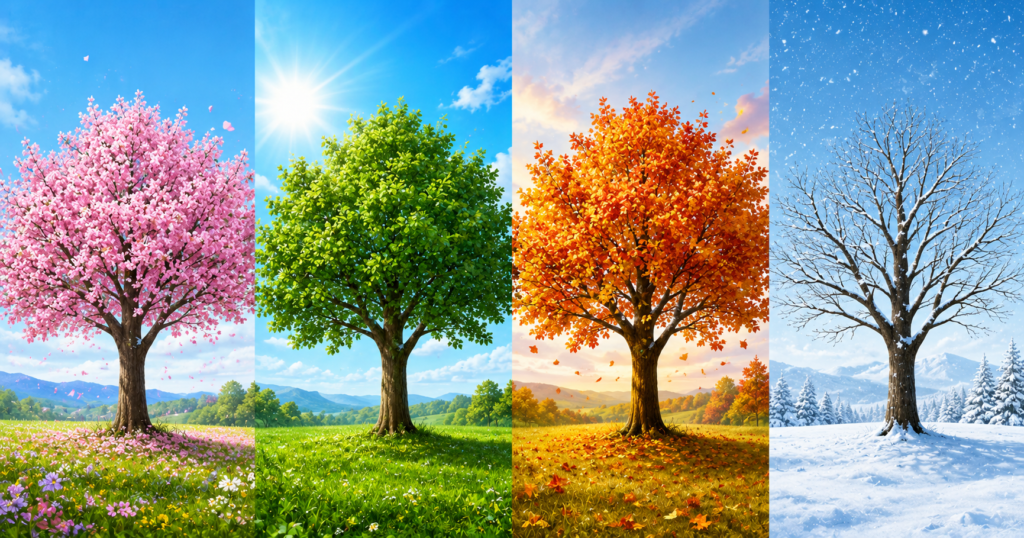
What Are the 4 Seasons? 🌸☀️🍂❄️
Look outside in December — it might be cold, dark and maybe even frosty. Now look again in June — warm, bright, and the evenings seem to go on forever. These dramatic changes in weather, daylight and the natural world around us are called seasons. Earth has four seasons: Spring, Summer, Autumn and Winter. Each one brings something different, and together they create the ever-changing rhythm of our planet.
But have you ever stopped to wonder — WHY do we have seasons at all? And why do they change so predictably, year after year? The answer is one of the most surprising facts in all of Earth science.
🤯 The Biggest Misconception in Science!
Almost everyone thinks winter is cold because Earth is far from the Sun. But this is completely wrong! Earth is actually3% CLOSERto the Sun in January (winter in the northern hemisphere) than in July. Distance is not the answer. Keep reading — the real reason is much more interesting!
📺 Watch the video first!
Why Do We Have Seasons? It’s All About Earth’s Tilt!
Seasons exist because Earth is tilted at 23.5 degrees on its axis as it travels around the Sun each year. Think of it like a spinning top that’s been nudged slightly sideways — Earth always leans at this same angle as it orbits. This tilt means that different parts of Earth receive sunlight from different angles at different times of year.
When your part of Earth tilts toward the Sun, sunlight hits more directly (like shining a torch straight down) and the days are longer, meaning more hours of heating. The result? Summer. When your part of Earth tilts away from the Sun, sunlight arrives at a steep angle (like shining a torch sideways across a surface, spreading the light more thinly) and the days are shorter. The result? Winter.
It’s not about closeness — it’s about angle and hours of daylight. That one difference explains everything.
The 4 Seasons — What Actually Happens in Each One?
🌸 Spring — March, April, May
Spring begins as Earth tilts back toward the Sun after winter. Days gradually lengthen, temperatures warm up and the natural world wakes up from its winter rest. Flowers push up through soil, buds appear on bare tree branches, migratory birds return from their winter homes, and baby animals are born across forests and fields. Spring is nature’s reset button — a burst of new energy after months of cold and quiet.
Typical temperatures (northern hemisphere): 8–18°C
☀️ Summer — June, July, August
Summer arrives when the northern hemisphere is tilted most directly toward the Sun. The Sun reaches high into the sky, its rays are at their strongest, and the days are the longest of the entire year. The longest day — the Summer Solstice around June 21st — can bring 16+ hours of daylight in the UK. In Scandinavia and Iceland, the Sun barely sets at all in midsummer — a phenomenon called the Midnight Sun. Animals are most active, plants grow rapidly and children are on their longest school holidays.
Typical temperatures: 20–35°C
🍂 Autumn — September, October, November
As Earth continues around the Sun, the northern hemisphere gradually tilts away again. Days shorten, temperatures drop, and one of nature’s most spectacular shows begins — the leaves change colour. Trees stop producing chlorophyll (the green pigment used for photosynthesis) as the days shorten and sunshine weakens. As the green fades, hidden red, orange and golden yellow pigments in the leaves are finally revealed. Trees then shed their leaves entirely to conserve energy and water for the cold months ahead. Meanwhile, animals prepare — some hibernate, some store food, some migrate south for the winter.
Typical temperatures: 6–15°C
❄️ Winter — December, January, February
Winter arrives when the northern hemisphere is tilted furthest from the Sun. The Sun stays low in the sky, days are shortest, nights are longest, and temperatures reach their coldest. The Winter Solstice around December 21st is the year’s shortest day. In places near the Arctic, there can be Polar Night — weeks of near-total darkness. Water freezes into frost, ice and snow. Animals that hibernate sleep through these months, and the natural world enters its deepest rest before spring’s return.
Typical temperatures: -10 to 5°C
Opposite Seasons — Australia’s Summer Christmas!
Here’s something that surprises many people: when it’s summer in the northern hemisphere (UK, Canada, USA, Europe), it’s winter in the southern hemisphere — and vice versa! This is because when the north tilts toward the Sun, the south tilts away at exactly the same time.
This is why Australians celebrate Christmas in hot summer sunshine — often having barbecues on the beach on December 25th! Countries near the equator — like Kenya, Singapore and Brazil — barely have four seasons at all. Their position means they receive fairly consistent sunlight year-round, giving them a warm climate throughout the year, usually split into a wet season and a dry season instead.
🌍 Wild Season Facts!
• Some trees literallycount cold winter daysto know when to start growing in spring — a process called vernalisation
• In Iceland in summer, the Sun sets for only about3 hours— it’s never fully dark
• A single large oak tree drops up to70,000 leavesin one autumn
• The word “season” comes from the Latin satio, meaning “a sowing of seeds”
•No two snowflakeshave ever been found to be identical — scientists have been searching for 100+ years
The Solstices and Equinoxes — The Season’s Turning Points
Four special days mark the start and midpoint of seasons throughout the year. The Summer Solstice (around June 21) is the longest day. The Winter Solstice (around December 21) is the shortest. The Spring Equinox (around March 20) and Autumn Equinox (around September 22) are the two days each year when day and night are exactly equal in length — the word “equinox” literally means “equal night” in Latin. Ancient civilisations like the Egyptians, Maya and Celts built monuments specifically aligned to the rising Sun on these exact days.
Frequently Asked Questions
A: Seasons are caused by Earth’s tilt of 23.5 degrees on its axis. As Earth orbits the Sun throughout the year, different parts of the planet lean toward or away from the Sun, receiving different amounts of sunlight and heat. When a region tilts toward the Sun, it experiences summer. When it tilts away, it experiences winter. Distance from the Sun does not cause seasons.
A: The four seasons in order are Spring (March–May), Summer (June–August), Autumn or Fall (September–November), and Winter (December–February) in the northern hemisphere. In the southern hemisphere, the seasons are reversed — summer occurs in December–February and winter in June–August.
A: Australia is in the southern hemisphere and the UK is in the northern hemisphere. When the northern hemisphere tilts toward the Sun (giving the UK summer), the southern hemisphere simultaneously tilts away (giving Australia winter). This is why Australians celebrate Christmas in summer sunshine while people in the UK experience summer in June and July.
A: No — countries near the equator (like Kenya, Singapore and Brazil) experience very little seasonal variation because they receive consistent sunlight year-round due to their position on the globe. Instead of four seasons, they typically have a wet season and a dry season. Four clearly distinct seasons are most pronounced in mid-latitude countries like the UK, USA, Canada, Australia and New Zealand.
A: A solstice is one of the two days in the year when day or night is at its longest. The Summer Solstice (around June 21st) is the longest day of the year in the northern hemisphere, with the most hours of sunlight. The Winter Solstice (around December 21st) is the shortest day, with the fewest hours of sunlight.
A: Leaves change colour in autumn because trees stop producing chlorophyll — the green pigment used for photosynthesis — as the days get shorter and less sunlight is available. As the green colour fades, the other pigments already in the leaves (red, orange and yellow) become visible. Trees then shed their leaves to conserve water and energy during the cold winter months.
Quick Recap — The 4 Seasons ✅
- ✅Seasons are caused byEarth’s 23.5° tilt— NOT by distance from the Sun
- 🌸Spring(Mar–May): tilting toward Sun, days lengthen, nature wakes up
- ☀️Summer(Jun–Aug): most tilted toward Sun, longest days, hottest temperatures
- 🍂Autumn(Sep–Nov): tilting away, days shorten, leaves change colour
- ❄️Winter(Dec–Feb): most tilted away, shortest days, coldest temperatures
- 🌍Northern and southern hemispheres always haveopposite seasons
- 📅The Solstices and Equinoxes mark each season’s key turning points
📖 Related posts you’ll enjoy:
→ How Does the Water Cycle Work?
→ How Do Volcanoes Work?
→ Earth Day Explained for Kids
→ How Do Oceans Work?