
Watch our fun volcano lesson on Sites for Kids and discover amazing science made simple!
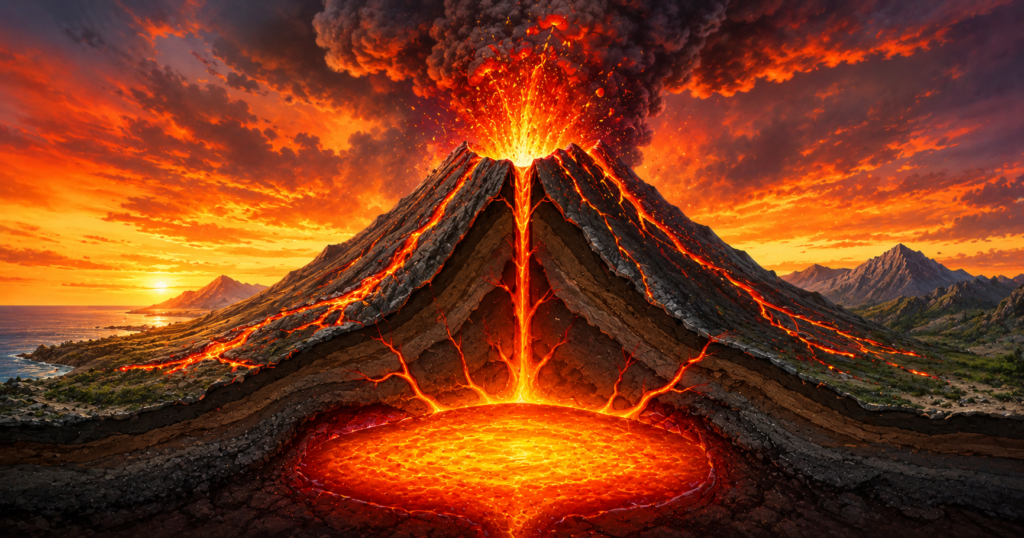
Deep beneath your feet — much deeper than any tunnel or mine — the Earth is so hot that solid rock melts into liquid. Most of the time, this molten rock stays safely underground. But sometimes, it finds a way up to the surface — bursting out as fiery lava, towering ash clouds, or explosive eruptions that can be heard hundreds of kilometres away. This incredible process is called a volcano, and it’s one of the most powerful natural events on our entire planet.
Volcanoes might seem scary, but they’ve also helped shape the world we live in — creating mountains, islands, and even some of the most fertile farmland on Earth. In this guide, we’ll explore exactly how volcanoes work, why they erupt, the different types you’ll find around the world, and some genuinely wild volcano facts.
What’s Inside a Volcano? 🌋
To understand volcanoes, you need to know what’s happening deep underground. Earth is made of several layers — and the layer just below the solid crust we walk on is called the mantle. The mantle is so hot that some of the rock there is partly melted, forming a thick, flowing substance called magma.
Magma is lighter than the solid rock around it, so it slowly rises — similar to how a bubble rises in water. It collects in underground pockets called magma chambers. When enough pressure builds up, the magma forces its way through cracks in the crust and up toward the surface — and that’s when a volcano can erupt.
🌋 Magma vs Lava — What’s the Difference?
This trips up a LOT of people!Magmais molten rock while it’s still UNDERGROUND. The moment it reaches the surface and flows out of a volcano, it’s calledlava. Same substance — different name depending on whether it’s above or below ground. Easy way to remember: “Lava is on the land (or air).”
Why Do Volcanoes Erupt? 💥
An eruption happens because of pressure. As magma rises toward the surface, gases trapped inside it (similar to the bubbles in a fizzy drink) start to expand. The closer the magma gets to the surface, the lower the pressure around it — and the more those gas bubbles expand, just like opening a shaken soda bottle.
If the magma is thick and sticky, gas bubbles get trapped and build up enormous pressure — leading to an explosive eruption, throwing ash, rock and gas high into the sky. If the magma is thin and runny, gases escape more easily — leading to a calmer effusive eruption, where lava flows out more gently, like a fiery river.
Types of Volcanoes 🗻
Not all volcanoes look the same! Their shape depends on the type of magma and how it erupts:
- 🗻 Shield Volcanoes — wide, gently sloping volcanoes formed by runny lava that spreads out over a large area before cooling. Hawaii’s Mauna Loa is a famous example — it’s actually the largest volcano on Earth by volume!
- 🌋 Composite Volcanoes (Stratovolcanoes) — tall, steep, cone-shaped volcanoes built up from alternating layers of lava and ash. Mount Fuji in Japan and Mount Vesuvius in Italy are classic examples. These tend to produce the most explosive eruptions.
- ⛰️ Cinder Cone Volcanoes — small, steep volcanoes made from chunks of solidified lava (cinders) that pile up around a vent. These are usually the smallest type and often erupt only once before becoming dormant.
- 🕳️ Calderas — huge crater-like depressions formed when a volcano’s eruption is so massive that the ground collapses inward afterward. Yellowstone National Park sits inside one of the largest calderas on Earth!
Where Do Most Volcanoes Form? 🌍
Earth’s crust is broken into huge pieces called tectonic plates, which are constantly (very slowly) moving. Most volcanoes form along the edges of these plates — especially around the edge of the Pacific Ocean, an area so packed with volcanoes and earthquakes that it’s nicknamed the “Ring of Fire.” About 75% of the world’s active volcanoes are found along this ring, including many in Japan, Indonesia, the Philippines, and the western coasts of North and South America.
Some volcanoes also form in the middle of tectonic plates, over extremely hot spots in the mantle called — appropriately — hotspots. The volcanic islands of Hawaii formed this way, as the Pacific plate slowly slides over a fixed hotspot deep below.
Are Volcanoes Always Dangerous? ⚠️
Volcanoes can definitely be dangerous — eruptions can produce lava flows, ash clouds, dangerous gases, and fast-moving mixtures of hot gas and rock called pyroclastic flows, which can travel over 700 km/h. But volcanoes also bring huge benefits:
- 🌱 Fertile soil — volcanic ash breaks down into incredibly nutrient-rich soil. Some of the world’s best farmland — in places like Italy, Indonesia and Iceland — exists because of nearby volcanoes.
- ♨️ Geothermal energy — countries like Iceland use heat from underground volcanic activity to generate electricity and heat homes, almost for free!
- 💎 New land and islands — entire islands, including Iceland and Hawaii, were built up over millions of years by repeated volcanic eruptions.
- 🪨 Valuable minerals and gemstones — diamonds are brought to the surface through a special type of volcanic eruption!
🤯 Wild Fact — The Loudest Sound in Recorded History
In 1883, the eruption of Krakatoa in Indonesia produced a sound so loud it was heard4,800 km away— roughly the distance from London to New York. People on islands thousands of kilometres away thought they were hearing cannon fire from a nearby ship. It remains the loudest sound ever recorded in human history.
🌋 Wild Fact — There’s Lava on Other Planets Too
Volcanoes aren’t just an Earth thing! Mars has the largest volcano in the entire solar system —Olympus Mons— which is about 2.5 times taller than Mount Everest and roughly the size of the state of Arizona. Jupiter’s moon Io is the most volcanically active object in our solar system, with eruptions so powerful that some lava is launched hundreds of kilometres into space!
How Do Scientists Predict Eruptions? 🔬
Scientists called volcanologists monitor active volcanoes for warning signs, including:
- 📈 Small earthquakes — as magma forces its way upward, it cracks rock and causes tremors
- 📐 Ground swelling — the surface of a volcano can physically bulge as magma builds up underneath
- 🌬️ Gas emissions — increases in gases like sulfur dioxide can signal rising magma
- 🌡️ Temperature changes — heat sensors and satellites track surface temperature changes around a volcano
While scientists can’t predict the exact moment of an eruption, these warning signs often allow enough time to warn nearby communities and save lives.
Quick Recap — How Volcanoes Work ✅
- ✅ Magma = molten rock underground. Lava = the same molten rock once it reaches the surface
- ✅ Eruptions happen when pressure from expanding gases forces magma up through the crust
- ✅ 4 main types: shield, composite, cinder cone and caldera volcanoes
- ✅ Most volcanoes form along tectonic plate edges — especially the Pacific “Ring of Fire”
- ✅ Volcanoes create fertile soil, geothermal energy, new islands — and even gemstones!
- ✅ Mars has the biggest volcano in the solar system — 2.5x taller than Mount Everest
📖 Related: How Does the Water Cycle Work? 🌧️ · What Are the 4 Seasons? 🍂 · How Do Oceans Work? 🌊 · Why Did Dinosaurs Disappear? ☄️