
In this lesson we are going to explore the fascinating world of plants — what they are, how they grow, how they make their own food, and some remarkable facts about the plant kingdom that will make you look at every leaf and flower in an entirely new way!
Plants are living organisms that belong to the Kingdom Plantae. There are approximately 390,000 known species of plants on Earth — ranging from microscopic algae to the giant redwood trees of California, which can grow over 115 metres tall and live for thousands of years.
What makes plants unique is their extraordinary ability to make their own food using sunlight — a process called photosynthesis. This makes plants autotrophs — self-feeders — unlike animals, which must eat other organisms to get energy. Plants are the foundation of nearly every food chain on Earth.
Most plants have the same basic parts, each with a specific job:
- 🌱 Roots — anchor the plant in the soil and absorb water and minerals. Some roots also store food — carrots and potatoes are actually roots!
- 🌿 Stem — supports the plant and transports water and nutrients between roots and leaves. Trees have woody stems called trunks.
- 🍃 Leaves — the main site of photosynthesis. Their flat shape maximises the surface area for absorbing sunlight.
- 🌸 Flowers — the reproductive organs of flowering plants. They attract pollinators like bees and butterflies to enable fertilisation.
- 🍎 Fruits and Seeds — fruits develop from fertilised flowers and contain seeds. Seeds can grow into new plants.
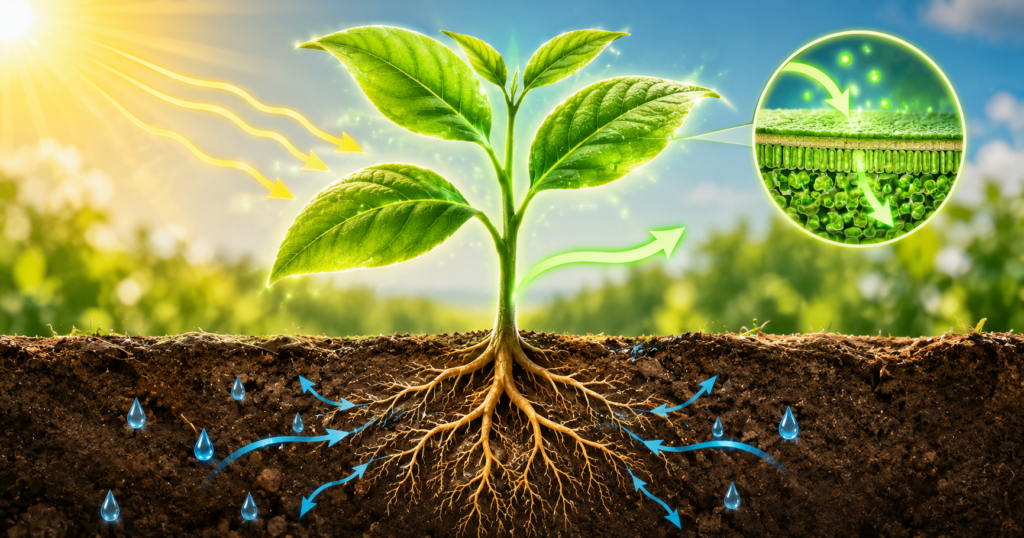
Photosynthesis is one of the most important chemical processes on Earth. It is how plants use the energy in sunlight to convert simple ingredients into food. The word comes from Greek: photo meaning light and synthesis meaning putting together.
Here is the simple recipe plants use:
- 💧 Water absorbed through the roots
- ☁️ Carbon dioxide absorbed from the air through tiny pores in leaves called stomata
- ☀️ Sunlight absorbed by a green pigment called chlorophyll in the leaves
These ingredients are combined to produce glucose (sugar — the plant’s food) and oxygen as a by-product. The oxygen is released into the air — which is where most of the oxygen we breathe comes from!
🌿 Why Are Plants Green?
Plants are green because of a pigment calledchlorophyll, which is found inside chloroplasts in plant cells. Chlorophyll absorbs red and blue light from the sun to use in photosynthesis — but it reflects green light back, which is why we see plants as green. In autumn, when days get shorter and temperatures drop, trees stop producing chlorophyll. As the green fades, other pigments — reds, oranges and yellows — that were hidden all along are revealed!
Plants grow from seeds. A seed contains everything a new plant needs to get started — an embryo (tiny plant), a food store and a protective coat. When a seed gets warmth, water and the right conditions, it germinates — the embryo starts to grow, sending a root down and a shoot up toward the light.
Plants grow by producing new cells at their growing tips — at the ends of roots and shoots — in a region called the meristem. Trees grow outward as well as upward — each year adding a new ring of wood, which is why you can count a tree’s age by counting the rings in its trunk. A tree with 500 rings is 500 years old!
Plants show tropisms — growth responses to their environment. Phototropism is when plants grow toward light — which is why houseplants lean toward the window. Gravitropism is when roots grow downward (toward gravity) and shoots grow upward.
Plants reproduce in two main ways:
Most plants reproduce using flowers. Flowers produce pollen (containing the male sex cells) which must reach the female parts of a flower to fertilise it. This transfer of pollen is called pollination. Pollinators — including bees, butterflies, moths, birds and bats — carry pollen from flower to flower in exchange for nectar. After fertilisation, the flower develops into a fruit containing seeds, which can be dispersed by wind, water, animals or exploding seed pods to grow new plants.
Ferns, mosses and horsetails reproduce using spores rather than seeds. Conifers (pine and fir trees) produce seeds in cones rather than flowers. Some plants can also reproduce vegetatively — growing new plants from existing roots, stems or leaves. Strawberry plants send out runners. Potatoes grow from underground tubers. Some plants can even grow from a single leaf!
- 🌬️ Oxygen production — plants produce the oxygen in our atmosphere through photosynthesis
- 🍽️ Food — almost all food on Earth comes from plants, or from animals that eat plants
- 🌡️ Climate regulation — forests absorb carbon dioxide and help regulate global temperature
- 🏠 Habitat — plants provide shelter and food for millions of animal species
- 💊 Medicine — over 70% of all medicines were originally derived from plants, including aspirin (willow bark) and morphine (poppies)
- 🏗️ Materials — wood, cotton, rubber, paper, rope — all come from plants
🌳 Amazing Plant Facts!
• The world’s oldest living tree is a bristlecone pine in California calledMethuselah— it is over4,850 years old!
• TheVenus flytrapis a carnivorous plant that catches and digests insects!
• TheAmazon rainforestproduces about 20% of Earth’s oxygen and is home to 40,000+ plant species
• Bamboo is thefastest growing planton Earth — some species grow up to 91cm in a single day!
• There are approximately3 trillion treeson Earth — more than 400 for every human being
- ✅ Plants are living organisms that make their own food using sunlight — around 390,000 species exist
- ✅ Main parts: roots, stem, leaves, flowers, fruits and seeds — each with a specific job
- ✅ Photosynthesis uses water + CO₂ + sunlight → glucose + oxygen
- ✅ Plants grow from seeds through germination and grow toward light (phototropism)
- ✅ Most flowering plants reproduce through pollination — with help from bees, butterflies and birds
- ✅ Plants produce our oxygen, food, medicines, building materials and regulate our climate
🎬 Watch Our Full Plants Video!
Subscribe to Sites for Kids for a new discovery every week 🌱✨